
RPA offers a wide range of possibilities and is bringing about lasting change to the way we work. However, automation and artificial intelligence are often associated with negative aspects such as layoffs or job losses. Looking back, however, the opposite is true: if we consider previous industrial revolutions, numerous new jobs have always been created. In the third part of our RPA blog series, we therefore explore the question of whether robots are replacing humans and why it is worthwhile to automate processes.
Will robots replace humans?
Just a few years ago, no one would have thought of creating content for social networks or writing a blog as a full-time job. Today, these are established professions that have emerged as a result of technological progress. However, the emergence of these new digital professions does not mean that newspaper or television journalists have been displaced or are redundant. Rather, people’s consumption habits have changed. Different media are used for different needs and complement each other as sources of information.
After the invention of ATMs, there was also concern that they would replace tellers at the counter—but that did not happen. ATMs have established themselves as trustworthy devices that provide us with account information and money. In contrast, we turn to bank branch employees when we have complex problems and questions. In particular, knowledge, experience, the development of new ideas, and personal contact cannot be replaced by a machine.
Both examples clearly show that automation should not be understood as synonymous with replacing workers. Humans and machines complement each other to support both employees and customers in their everyday lives. What does this mean for the use of RPA in companies?
How can RPA support us in our work?
We often make our work easier by using certain programs, such as Excel. They help us to complete tasks faster, better, and with fewer errors. Like Excel, RPA is a tool that can be used for activities in almost all areas of business. Another advantage is that RPA is highly customizable and can be easily tailored to your own needs.
RPA enables bots to perform entire routine processes. These can be actions such as extracting information from a document and editing it in Excel, then entering it into an ERP or CRM system and creating a report.
However, it can also involve creating time sheets and invoices, monitoring deadlines, or consolidating and reconciling accounts. Payroll accounting and tax forms can also be simplified using a bot, and the relevant information can be forwarded to the tax authorities.
The range of tasks that can be handled by RPA is very broad. Just think of the repetitive, monotonous, and time-consuming tasks that are of little value to the company.
Perhaps while reading this, you have thought of a task that you have to do repeatedly—this is exactly where a bot can help.
The robot works similarly to a personal assistant with additional advantages: it can work on our instructions (a so-called serviced robot) or automatically work for us in our free time. The robot takes care of all the additional, sometimes tedious but necessary tasks. In our case, for example, it would be the office plants, which we regularly forget to water and which would be very grateful to the bot.
Redistribute tasks
Merging reports, sending emails, transferring information from one system to another—these are all important tasks in our work. However, they are very time-consuming and relatively insignificant.
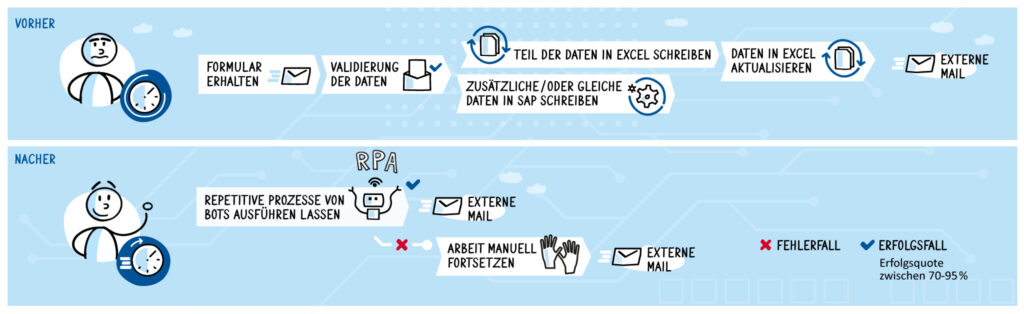
Using a robot can reduce the time required to perform these tasks by up to 35%. In addition, the task no longer has to be performed entirely by a human being; instead, the human would only spend part of the time validating the work performed by the robot.
In the event of an error, e.g., if business rules are not followed or human expertise is required, this information would be manually forwarded to a human who would continue the work where the robot left off.
Lower workload, greater satisfaction
A simple use case from everyday working life is time recording. Before automation, one person had to log into the time recording application several times a week and check whether all employees had uploaded the information to the system. If information such as hours was missing, an email had to be written manually requesting that the missing information be added. The person responsible then waited until the hours were uploaded and repeated the process again.
This happened every Friday and Monday: a repetitive, tedious, and exhausting process. With the use of a robot, these tasks no longer need to be performed by an employee. A bot runs automatically every Friday afternoon and Monday morning, accessing the time tracking system to load the hours and checking whether all employees have recorded their hours. If this is not the case, the robot automatically sends an email to the person concerned, asking them to complete the missing information.
Thanks to automation, the person responsible for the task is now only responsible for checking that the report sent by the robot is correct and then forwarding it to their superiors for review.
The automated process not only speeds up the entire procedure, but also reduces the workload for staff in their day-to-day work, freeing up time for more valuable activities.

Another example where robots can be used to provide support is in the preparation of reports. This is a task that is part of the work in various professions and industries. Here are two examples:
The main responsibilities of managers are to lead teams, provide information, and achieve common goals. Although writing reports is also part of the job, it is not the core of the work.
The situation is similar in administrative professions. It is common for employees to work beyond regular working hours and thus work overtime in order to prepare documents and reports on time. These reports are often intended to improve planning, avoid stress, and minimize risks. However, the opposite is often the case: stress increases and mistakes are made. This can also affect the quality of life of those involved, who have less time for their private lives due to the high workload. Several studies link job dissatisfaction with higher rates of illness in the medium and long term (source: e.g., Hannah Nichols, Job dissatisfaction has negative health effects by age 40). So wouldn’t you rather use a tool like RPA that takes care of tasks like these for you?
What processes and tasks are involved in your company? And if you already have ideas, which activities could you then complete at your leisure or in good time without having to work overtime?
The most important points summarised:
- Robots do not replace humans, but rather support them in their work.
- By delegating monotonous tasks, employees have more time to concentrate on important tasks.
- This also increases motivation, enjoyment, and satisfaction at work, and improves quality of life.
Outlook
In our next blog post, we will look at the first steps relevant to the introduction of process automation with RPA. Among other things, the selection of the RPA provider, the governance model, and the requirements and needs of the company play an important role here.
 RPA – a technology with social relevance (blog series part 2)